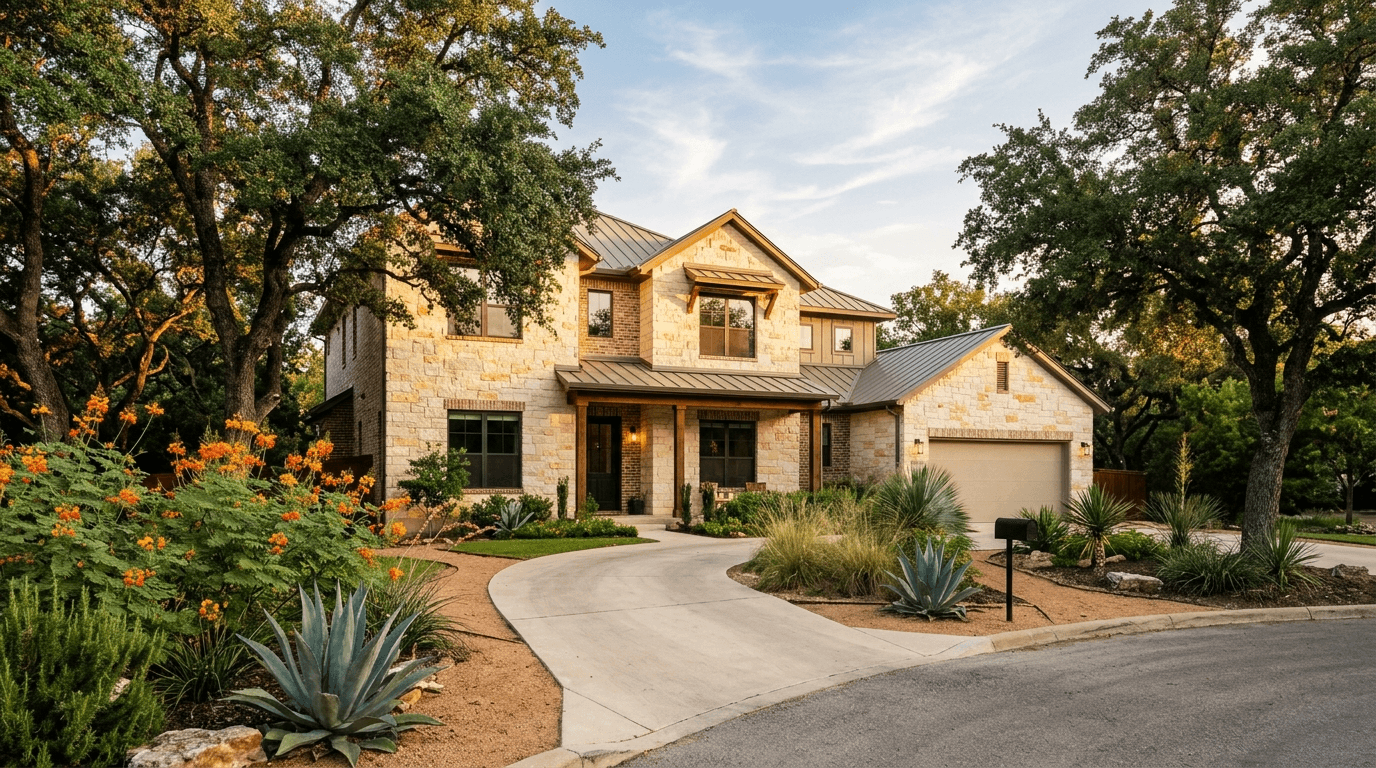

Short answer: Homeowners in Texas are able to use a cash-out refi to buy another home whether it's a new primary or a second home. Fannie Mae and Freddie Mac allow you to use the equity proceeds to apply towards a down payment, closing costs, or a full purchase of another home. For Texas homesteads, Section 50(a)(6) laws cap the combined CLTV at 80% of the appraised value and also require a 12-day wait period for any cash-out refinances. Both mortgage payments will also be considered in your DTI ratio.
Introduction
Texas homeowners with a low-rate existing mortgage face an interest rate trade-off before refinancing. Federal Housing Finance Agency data from mid-2026 showed roughly 60% of outstanding Texas mortgages carried rates below 5%.
Freddie Mac reported a 30-year fixed average of 7.18% for the week of November 5, 2026. That figure is a national survey average rather than a rate quote, and your rate and APR depend on credit history, loan program, and points. Because a cash out refinance replaces your current mortgage with a larger loan, your old rate disappears across the entire mortgage balance.
Cash out refinance to buy second home: how the two loans work
Using existing home equity to buy a second home normally involves two separate mortgage loan transactions and two closings. First, a cash out refinance loan on your current residence pays off your original mortgage and wires the remaining cash out refinance proceeds to you as a lump sum. Second, that cash covers the down payment and upfront costs on the vacation property while a new mortgage finances the rest of the purchase price.
Fannie Mae's cash-out refinance rules permit equity proceeds for any purpose and set two seasoning clocks on the property you refinance. "If an existing first mortgage is being paid off through the transaction, it must be at least 12 months old at the time of refinance, as measured by the note date of the existing loan to the note date of the new loan." Fannie Mae's ownership policy adds: "At least one borrower must have been on title to the subject property for at least six months prior to the disbursement date of the new loan."
Should you use home equity to buy a second home?
Replacing a low-rate first lien raises interest charges across the debt you already owe, while a second mortgage reprices only the new cash you pull. Take a primary home worth $500,000 with a $250,000 loan balance and 27 years left on its loan term.
Pulling $80,000 for the down payment and purchase closing costs on a $350,000 second home compares rolling refinance costs into one cash-out loan against keeping your first lien and adding a fixed second lien.
| Option | Blended rate | Monthly principal and interest | Interest paid in first five years |
|---|---|---|---|
| Keep a 3.5% first, add an $82,000 second lien (8.5%, 20-year, $2,000 costs rolled in) | 4.73% | $1,906 | $74,200 |
| Keep a 4.5% first, add the second lien | 5.49% | $2,046 | $86,400 |
| Keep a 5.5% first, add the second lien | 6.24% | $2,194 | $98,700 |
| Keep a 6.5% first, add the second lien | 6.99% | $2,351 | $111,200 |
| Replace first with a $337,000 cash-out loan (7.0%, 30-year, $7,000 costs rolled in) | 7.00% | $2,242 | $114,700 |
Anything below a 5% or 5.5% mortgage rate, keeping the original loan along with adding a second mortgage, will produce lower monthly obligations and a lower 5-year interest cost. At 6.5% or higher you extend the balance over one 30-year cash-out loan.
Using a HELOC or second mortgage to buy a second home
Opening a home equity loan or HELOC on a Texas homestead follows the same Section 50(a)(6) 80% combined loan to value ratio cap and 12-day wait as a cash-out refinance. Under Section 50(t), a Texas HELOC also sets a $4,000 minimum loan draw and bars credit-card access to the home equity line.
If the first mortgage is already a home equity loan (which can be confirmed through a title commitment), the Texas Constitution allows only one home equity loan at a time. Refinancing both into one new cash-out or having a rate-and-term refinance in the first lien and an equity loan on the second lien is also okay if the home is your homestead.
When a cash out refi is the wrong move
Borrowing against your primary home ties a vacation purchase to your household shelter and raises foreclosure risk if your financial situation changes. Even with Texas court-order foreclosure rules, defaulting on a larger mortgage can cost you your primary residence.
Under IRS rules in IRS Publication 936, "Interest on home equity loans and lines of credit are deductible only if the borrowed funds are used to buy, build, or substantially improve the taxpayer's home that secures the loan." Interest on equity pulled from your homestead to buy another house fails that test, as covered in our HELOC interest tax guide. Interest on the purchase mortgage secured by the second home itself can still qualify when you meet personal-use rules.
Buyers who plan to move into the new house full-time are purchasing a new primary residence rather than a second home. Relocating calls for a primary-residence loan or a short-term bridge loan, covered in buying a house before selling yours.
Cash-out refinance requirements to buy a second property
Conventional cash out refinances and second-home purchase loans require you to qualify on both properties at the same time. Lenders typically require borrowers to meet six underwriting standards across the two files:
- At least 20% equity left in a Texas homestead after closing, capping your loan to value ratio at 80%
- At least 25% equity left when refinancing a vacation home or one-unit rental, capping the loan to value ratio at 75%
- Credit report review, where Desktop Underwriter sets no score cutoff and most lenders price cash-out and second-home loans starting at a 620 to 680 credit score
- Debt to income ratio of 43% to 45% under standard guidelines, or up to 50% with automated Desktop Underwriter approval
- Cash reserves of 2 months of housing payments on the second home purchase, rising to 6 months on a cash-out file over 45% DTI
- Upfront fees, lender fees, and closing costs of 2% to 5% of the loan amount, plus any lender minimum loan amount rules
Is the primary home you are tapping a Texas homestead?
Texas Constitution Article XVI, Section 50(a)(6) regulates equity borrowing only on your Texas homestead, meaning the one primary home you occupy and claim in Texas. A rental house or vacation property you already own falls instead under standard Fannie Mae Eligibility Matrix and Freddie Mac Guide rules.
Article XVI, Section 51 provides that "any temporary renting of the homestead shall not change the character of the same, when no other homestead has been acquired." Title companies require a non-homestead affidavit before closing a conventional cash-out on a Texas property you do not occupy.
| Rule | Your Texas homestead | Vacation home you already own | One-unit rental you already own |
|---|---|---|---|
| Max loan to value ratio | 80%, all liens combined | 75% | 75% (70% for 2 to 4 units) |
| 12-day wait before closing | Yes | No | No |
| Right to cancel after closing | Yes, 3 business days | No | No |
| Lender fee cap | 2% of principal, with exclusions | No Texas cap | No Texas cap |
| Borrowing frequency | One Section 50(a)(6) loan per 12 months | No Texas limit | No Texas limit |
| Recourse on default | Court-ordered foreclosure, non-recourse absent fraud | Standard loan terms | Standard loan terms |
| Signing location | Lender, attorney, or title company office | Standard closing options | Standard closing options |
| Extra collateral | Prohibited, barring blanket loans across both homes | Allowed where lender permits | Allowed where lender permits |
| Appraisal requirement | Full new appraisal every time, one-unit only | DU value acceptance eligible | DU value acceptance eligible |
| Converting to a regular loan | Section 50(f)(2) after 1 year, no cash back, 80% max LTV | Standard rate-and-term rules | Standard rate-and-term rules |
Cashing out or putting a HELOC on a vacation home you already own
Texas homeowners that own a resort-style home, whether a lake house or a beach condo, with enough equity can also do a cash-out on that second home instead of touching their primary residence. Fannie and Freddie will cap a second-home cash-out at 75% of the appraised value and homestead laws like the 12-day wait period don't necessarily apply anymore.
Standalone HELOCs on a vacation home come from portfolio banks and credit unions because neither agency buys home equity lines. Portfolio lenders generally cap second-home lines at 70% to 75% combined loan to value.
Ready to tap into your home equity?
See custom rates and loan scenarios tailored to your budget in minutes. No hard credit pull, zero obligation.
What Section 50(a)(6) changes on a homestead cash-out
Texas Section 50(a)(6) bars securing a homestead equity loan with additional real estate, which rules out a single blanket loan across your existing property and the second home. Fannie Mae's Texas Section 50(a)(6) guide adds an appraisal rule: "Lenders must obtain a new appraisal to determine the property's current value even if DU offers value acceptance, or a value acceptance + property data option." Full state rules appear on our Texas cash-out refinance page.
How much cash can you take out?
How much equity you can pull from a Texas homestead equals 80% of property value minus every lien owed on the home. On a homestead appraised at $500,000, that ceiling sets a $400,000 maximum loan amount.
Subtracting a $250,000 current mortgage leaves $150,000 before closing costs, or $143,000 net cash after rolling costs in, and you can test your own home value in our home equity calculator.
Online calculators that promise "80% of your home equity" state the formula wrong and overstate that example by $50,000, because Texas measures the cap against appraised value rather than equity.
How to time the refinance and the new mortgage
Closing a Texas homestead cash-out refinance takes at least 16 calendar days from formal Section 50(a)(6) notice and application to wire funding because the 12-day wait and 3-day rescission period cannot be waived.
- Open both loan files with one loan officer so underwriting counts both mortgage payments from day one
- Sign the Texas Section 50(a)(6) notice to start the 12-day clock and order the homestead appraisal
- Sign cash-out closing papers at a title company, attorney office, or lender office on or after day 12 and complete the 3-day rescission window
- Receive wired cash-out proceeds in your bank account and send the Closing Disclosure and wire trail to the purchase underwriter
- Close and fund the new mortgage on the second home
Your financing contingency will cover through a loan approval on purchase loans. That addendum (Form 40-11) doesn't necessarily protect your earnest money if a separate primary residence appraisal doesn't come in to value or your waiting period runs late. It would be considered two separate transactions as a standalone.
What counts as a second home?
Fannie Mae and Freddie Mac define a second home as a one-unit property you occupy part of the year, suitable for year-round living and under your exclusive control. Timeshares and mandatory rental pools do not qualify. Fannie Mae states: "A property must be delivered as an investment property when the requirements for principal residence or second home occupancy are not met, including when the property is primarily held or operated as a rental property." Neither agency enforces a 50-mile rule, though individual lenders can add distance overlays.
Do you need 20% down on a vacation home?
No. Fannie Mae and Freddie Mac allow up to a 90% loan to value ratio on a conventional second-home purchase, setting the minimum down payment at 10% with mortgage insurance required under 20% down.
The 2026 FHFA conforming limit for a single-unit home is $832,750 in every Texas county, and larger loans require a jumbo mortgage.
Why 25% down can beat 20%
Fannie Mae applies loan-level price adjustments to second-home purchases and cash-out refinances based on credit score and loan to value tiers. Under the Fannie Mae LLPA Matrix dated September 30, 2026, moving from 20% down to 25% down cuts the second-home fee by 1.75 points.
| Loan transaction, 740 to 759 credit score | Loan to value | Combined Fannie Mae LLPA |
|---|---|---|
| Second home purchase, 10% down | 90% | 4.875% |
| Second home purchase, 20% down | 80% | 4.250% |
| Second home purchase, 25% down | 75% | 2.500% |
| Homestead cash-out refinance | 60.01% to 70% | 1.000% |
| Homestead cash-out refinance | 70.01% to 75% | 1.625% |
| Homestead cash-out refinance | 75.01% to 80% | 2.375% |
| Cash-out on a vacation home or one-unit rental | 75% | 3.750% |
Grabbing an extra 5% off your primary residence when you refi, when you have room under the 80% LTV cap, and pricing this out compared to 1.75 points saved on your purchase is worth running side by side.
How both mortgage payments hit your debt to income ratio
Underwriters divide your combined housing bills on both properties plus monthly consumer debts by your gross monthly income, and cash-out funds cannot satisfy the refinance's own reserve rule. Fannie Mae's borrowed-funds rule states: "Borrowed funds secured by an asset are an acceptable source of funds for the down payment, closing costs, and reserves." It adds: "When qualifying the borrower, the lender must consider monthly payments for secured loans as a debt."
Adding a $280,000 second-home loan at a round 7.5% example rate with unexempt property taxes shows the income gap between the two paths, which you can test in our DTI calculator.
| Monthly obligation on $280,000 second-home loan | Cash-out refinance path | Keep 3.5% first, add home equity loan |
|---|---|---|
| Homestead principal and interest | $2,242 | $1,906 |
| Homestead property taxes and insurance | $900 | $900 |
| Second home principal and interest | $1,958 | $1,958 |
| Second home property taxes and insurance | $833 | $833 |
| Auto and other monthly debts | $500 | $500 |
| Total monthly debt | $6,433 | $6,097 |
| Gross income needed at 45% DTI | About $171,600 a year | About $162,600 a year |
Buying a second home or investment property with cash-out proceeds
Qualifying with rental income on an investment purchase
Buying a property primarily to rent out classifies the loan as an investment property, capping a one-unit conventional purchase at 85% loan to value with 15% down and 6 months of reserves. Unlike a second-home file, projected market rent on Form 1007 or an existing lease can help you qualify under our FNMA rental income guide.
Tapping a rental property instead of your primary home
When you extract equity from a second home or investment property that isn't your homestead, it skips the Section 50(a)(6) Texas rules. Homeowners that compare a conventional loan versus an investment property refi or a DSCR cash-out refi, or even an investment property HELOC, can compare to see what makes the most sense.
Frequently asked questions
The Texas 2% rule caps lender and origination fees on homestead equity loans rather than interest or bona fide discount points. Section 50(a)(6)(E) requires that the loan "does not require the owner or the owner's spouse to pay, in addition to any interest or any bona fide discount points used to buy down the interest rate, any fees to any person that are necessary to originate, evaluate, maintain, record, insure, or service the extension of credit that exceed, in the aggregate, two percent of the original principal amount of the extension of credit." Third-party appraisal fees, surveys, and state base title premiums sit outside the 2% cap.
Two separate 12-month rules govern a Texas homestead cash-out refinance. Fannie Mae and Freddie Mac require an existing first mortgage being paid off to be at least 12 months old from note date to note date, while Texas Section 50(a)(6)(M)(iii) allows only one home equity loan or cash-out refinance on the same homestead every 12 months outside declared disasters.
No. Both HUD Handbook 4000.1 for FHA and 38 U.S.C. Section 3710 for VA require primary-residence occupancy, so neither loan program finances a vacation home purchase or a non-homestead cash-out refinance in any state. On a Texas homestead, Texas Attorney General Opinion KP-0183 concluded in 2018 that Section 50(a)(6)(H) prohibits VA cash-out refinances because the federal guaranty counts as additional collateral, and lenders do not offer FHA Section 50(a)(6) cash-out loans in Texas.
Absolutely because when you're under 80% max LTV with a homestead cap, it covers, or can cover, the entire purchase price and closing costs while you buy a second home in cash and then just carry one mortgage payment. If you finance a second home within 6 months under DU and LP, it stands for delayed financing exceptions. All new cash-out proceeds must be paid down on the home equity loan or HELOC that funded the previous cash purchase. Check with your lender for specific overlays here.
Every borrower's situation is unique. The guidelines above are general, so speak with a licensed loan officer about how they apply to you.
Ready to tap into your home equity?
Tell us your budget and a licensed loan officer will show you the options that fit it.
Get started